
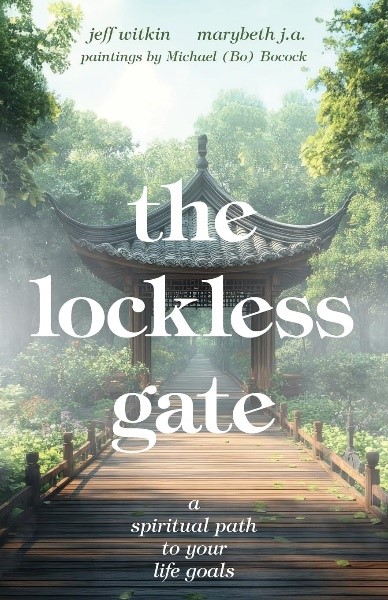
The Lockless Gate: A Spiritual Path to Your Life Goals is a deeply thoughtful, quietly powerful, and spiritually grounded guide for readers who feel the ache of unrealized dreams but do not yet know how to begin moving toward them. Written by Jeff Witkin and Marybeth J.A., the book speaks directly to those who may feel directionless, emotionally divided, spiritually restless, or simply unsure of how to translate longing into meaningful action. It does not treat goal-setting as a mechanical exercise or a shallow productivity formula. Instead, it approaches the creation of a meaningful life as something far more integrated — a process involving the body, the mind, the spirit, one’s relationships, and one’s responsibility to the wider human community.
What makes this book immediately distinctive is the compassion at the heart of its premise. The authors do not write from a place of superiority, as though they are handing down instructions from a distance. They write as fellow travelers. The opening assurance — that they have stood where the reader stands — gives the book an atmosphere of genuine companionship. This is not a cold manual for achievement, nor is it an abstract meditation on spirituality. It is a field guide for people who want to live with greater intention, but who also need encouragement, structure, and a sense that their dreams are not foolish, selfish, or impossibly far away.
The title itself, The Lockless Gate, is beautifully suggestive. A gate normally implies separation, restriction, or permission withheld. But a lockless gate suggests something else entirely: an opening that has always been available, a passage that may appear closed only because one has not yet stepped toward it. This image becomes an elegant metaphor for the book’s central message. The life one desires is not reached through force alone, nor through wishful thinking, but through the courage to take one step, then another, toward a fuller and more conscious way of being. The book’s guiding line — “The reality of creation in the physical, artistic, and spiritual world begins with one step” — captures the entire spirit of the work with memorable simplicity.
Jeff Witkin’s background gives the book a unique intellectual and emotional texture. As a psychologist, scientist, and poet, he brings together disciplines that are too often treated as separate. The psychological dimension gives the book practical grounding; the scientific dimension gives it clarity and structure; the poetic dimension gives it warmth, imagination, and spiritual resonance. The result is a work that feels both purposeful and humane. It understands that people do not change their lives merely by receiving instructions. They change when they begin to see themselves differently, when they recognize their connection to others, and when they learn to align their actions with a deeper sense of meaning.
Marybeth J.A.’s presence adds another essential layer to the book. Her life experience, shaped by theater, travel, service, and spiritual exploration, broadens the book’s perspective beyond conventional self-help. The path presented here is not narrow or rigid. It is exploratory, creative, relational, and alive. The book understands transformation not as a single breakthrough moment but as an unfolding journey. It allows room for uncertainty, discovery, failure, renewal, and wonder. This gives the work a generosity that many goal-oriented books lack.
One of the book’s most compelling strengths is its insistence that personal fulfillment cannot be separated from one’s impact on others. Many books about dreams and goals focus almost exclusively on individual success. The Lockless Gate takes a broader and more spiritually mature view. It is built on the fundamental truth that human beings do not live separately from one another. A dream life, in this vision, is not merely a life of private satisfaction. It is a life that touches, uplifts, and contributes to the lives of others. This emphasis gives the book moral seriousness without making it heavy-handed. It reminds the reader that the pursuit of one’s goals can be an act of service when those goals are rooted in love, awareness, and responsibility.
The book also succeeds because it treats the first step as sacred. In a culture obsessed with final outcomes, public success, and visible achievement, Witkin and Marybeth return the reader to the quiet dignity of beginning. That is where the book’s wisdom becomes most practical. The first step may be small, but it is never meaningless. It is the moment in which imagination becomes movement, desire becomes commitment, and spiritual longing begins to take physical form. This approach is especially valuable for readers who feel overwhelmed by the size of their dreams. The book does not demand that they solve their entire life at once. It invites them to begin.
The tone throughout is encouraging without becoming sentimental. The authors understand discouragement, but they do not romanticize it. They recognize that many readers will come to the book feeling tired, undefined, or emotionally distant from the life they once imagined for themselves. Rather than offering simplistic promises, the book offers a path — and that distinction matters. A promise can feel empty when life is difficult, but a path gives the reader something to walk. The Lockless Gate is most effective when it positions itself not as an instant answer but as a companion for the journey.
There is also a subtle but important artistic quality to the book. The language of creation appears throughout the description of its purpose: physical creation, artistic creation, spiritual creation. This gives the book a wider relevance than a standard life-goals guide. It will speak not only to readers seeking career direction or personal clarity, but also to artists, seekers, caregivers, spiritual learners, and anyone who senses that their life contains unrealized creative energy. The book honors that energy. It treats the dream life not as a fantasy but as something that can be shaped, practiced, and gradually embodied.
What ultimately distinguishes The Lockless Gate is its integration. It does not divide life into isolated categories: ambition over here, spirituality over there, relationships somewhere else. Instead, it presents the human person as whole. Goals are not merely tasks to be completed; they are expressions of what a person believes, loves, values, and hopes to become. This holistic vision gives the book its emotional force. It asks readers not only what they want, but why they want it, whom it will affect, and what kind of person they must become in order to live it honestly.
The book is especially well suited for readers standing at a threshold. That threshold may be personal, professional, creative, spiritual, or emotional. It may belong to someone beginning again after disappointment, someone trying to define a long-delayed dream, someone searching for a more meaningful structure for daily life, or someone who simply feels that there must be more to existence than routine and survival. For such readers, The Lockless Gate offers both comfort and challenge. It comforts by saying, “You are not alone.” It challenges by saying, “Begin.”
By the end, the book leaves the impression of a work written with sincerity, intelligence, and a genuine desire to help others move toward a fuller life. Jeff Witkin and Marybeth J.A. have created more than a motivational guide; they have created a spiritual invitation. The Lockless Gate reminds readers that the passage toward purpose may not be locked at all. It may simply be waiting for the courage of one deliberate step.