
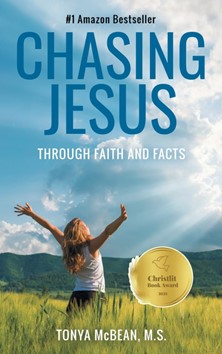
Tonya McBean’s Chasing Jesus: Through Faith and Facts is a sincere, passionate, and deeply personal work of Christian testimony and apologetic reflection, written with the clear intention of strengthening faith where it has grown uncertain and awakening faith where it has not yet taken root. As a companion to McBean’s larger Chasing Series, this book functions not merely as another devotional volume but as a kind of spiritual summation — a work that gathers together the author’s personal experience, biblical conviction, historical inquiry, and urgent evangelistic concern into one direct and heartfelt message: Jesus must be more than an idea, more than a seasonal comfort, and more than a distant religious figure. He must be front and center in the life of the believer.
From the opening pages, McBean establishes the defining principle of the book with admirable clarity. Her faith in Jesus Christ is not presented as an accessory to her life, but as its governing reality. She writes from the perspective of someone who believes that Jesus is the true light, the Son of God, the source of salvation, and the only foundation strong enough to carry a person through both joy and suffering. This conviction gives the book its emotional force. Chasing Jesus is not written in a detached academic tone, even when it deals with historical and evidential arguments. It is written as testimony — urgent, grateful, personal, and unashamed.
One of the most compelling elements of the book is the way McBean begins with lived experience before moving into evidence. Her story of divorce, trauma, single motherhood, prayer, counseling, and eventual restoration gives the book an immediate human grounding. She does not speak about faith as an abstract concept preserved in church language. She speaks of faith as something she leaned on when she was broken, frightened, and trying to rebuild a life that had been deeply wounded. The image of her crying with the Bible in her lap is one of the book’s quiet emotional centers, because it reveals the origin of the author’s authority. She is not writing as someone who has merely studied Christian claims; she is writing as someone who has needed them to survive.
The early chapters also reveal McBean’s gift for making spiritual truth practical. Her reflections on marriage, healing, emotional recovery, and daily obedience are straightforward but meaningful. She emphasizes the importance of guarding one’s heart and thoughts, breaking difficult seasons down into one day at a time, doing the next right thing, and placing tomorrow in God’s hands. These are not decorative phrases. They form a spiritual discipline for readers who may be in the middle of pain, uncertainty, or relational hardship. In this sense, the book offers both encouragement and instruction. It tells readers that God can take something horrible and create something wonderful, but it also reminds them that healing is gradual, intentional, and rooted in obedience.
What gives Chasing Jesus its distinctive identity, however, is the author’s desire to unite faith with facts. McBean is especially concerned with readers who believe but feel intellectually unprepared to explain why they believe. She openly acknowledges that her faith began in childhood, but that later in life she wanted evidence — not to replace faith, but to support and strengthen it. This honest admission is one of the book’s strongest features. It recognizes a struggle many Christians quietly experience: the need to reconcile inherited belief, personal experience, historical evidence, and modern skepticism. McBean does not dismiss questions as threats to faith. Instead, she treats them as invitations to search more deeply.
The apologetic sections of the book draw from familiar and influential Christian evidence writers, including Lee Strobel, Josh McDowell, Sean McDowell, William Lane Craig, Gary Habermas, Jeremiah Johnston, and others. McBean uses these sources to build a case around several central questions: Can we trust the Bible? Did Jesus really exist? Did he truly rise from the dead? Can Jesus still change a life today? These questions give the book its structure and momentum. They are not presented as distant theological puzzles, but as matters of eternal importance. For McBean, the decision one makes about Jesus is the most important decision one can make, and the book carries that urgency on nearly every page.
Her discussion of non-Christian historical sources is especially significant within the book’s argument. McBean points readers toward figures such as Tacitus, Josephus, and Suetonius as part of her case that Jesus was not merely a literary or religious invention, but a historical person recognized outside the biblical record. She presents these writers as important because they were not Christian evangelists trying to advance the faith. Their references to Jesus, Pilate, the crucifixion, early Christians, and the surrounding historical context serve, in McBean’s reading, as external confirmation of the Gospel record. This gives the book an evidential dimension that many devotional works do not attempt.
Equally central is the book’s emphasis on the resurrection. McBean treats the resurrection not as one doctrine among many, but as the cornerstone of Christian faith. If Christ did not rise, she insists, faith is empty. If he did rise, then everything changes. Her treatment of the resurrection is direct and forceful: Jesus died by crucifixion; Roman soldiers were trained executioners; Pilate confirmed his death; his body was buried; and the disciples later proclaimed his resurrection despite persecution, suffering, and death. The argument is not presented with academic detachment but with devotional intensity. McBean wants the reader to feel the weight of the claim and the consequences of accepting or rejecting it.
The section listing the post-resurrection appearances of Jesus is one of the book’s clearest attempts to organize evidence for the reader. Mary Magdalene, the women leaving the tomb, Peter, the disciples on the road to Emmaus, the gathered disciples, Thomas, the seven by the Sea of Galilee, the eleven in Galilee, more than five hundred people, James, the apostles, and the ascension are presented as a cumulative witness. The purpose is not simply to list events, but to demonstrate that the resurrection claim was not built on a single private vision or vague spiritual feeling. McBean sees the resurrection as a public, repeated, transformative encounter that changed fearful followers into bold witnesses.
Another major strength of the book is its use of archaeology and manuscript evidence. McBean’s references to the Pilate stone, Caiaphas, Herod, Bethlehem, Nazareth, Capernaum, the Pool of Siloam, and other archaeological confirmations are intended to show that the world of the Bible is not imaginary but historically situated. She also emphasizes the abundance of biblical manuscripts compared with other ancient works, presenting this as a reason readers can have confidence in the reliability of Scripture. This section will appeal especially to readers who are reassured by concrete details and historical anchors. McBean understands that faith often becomes stronger when readers can see that Christianity is rooted in history, not myth.
The book also moves into intelligent design, arguing from the complexity of DNA, the human body, the eye, the ear, and the limitations of even advanced robotic technology when compared to God’s design. These passages reflect McBean’s conviction that creation itself testifies to a Creator. Her prose becomes particularly emphatic here, pressing readers to consider whether randomness can adequately explain the complexity and elegance of life. While readers from different backgrounds may engage these arguments differently, the author’s purpose is unmistakable: she wants to restore wonder. She wants the reader to look at the body, the natural world, and the intricacy of existence and see evidence of intention rather than accident.
Yet Chasing Jesus is not only a book of evidence. It is also a book about endurance. McBean repeatedly returns to the reality of suffering and the necessity of trusting Christ through it. She does not present Christianity as a promise of ease. In fact, she is clear that following Jesus may be difficult, that hardship serves a purpose, and that trials can lead believers more deeply into the joy of the Lord. This gives the book a necessary balance. It does not claim that faith removes every wound. Instead, it teaches that faith gives meaning, strength, and hope when wounds remain.
The later reflections on persecution, freedom, and blessedness broaden the book’s scope beyond the individual reader. McBean reminds American Christians that many believers around the world face severe persecution, and that the freedom to worship should not be taken lightly. This section adds moral urgency to the book’s devotional purpose. To chase Jesus is not merely to seek personal comfort; it is to remain faithful when obedience is costly, to value worship as a gift, and to recognize that Christianity has always required courage.
The discussion of what it means to be blessed is among the most spiritually mature elements of the book. McBean does not define blessedness as material comfort or the absence of trouble. Instead, she describes it as a deep spiritual state of well-being rooted in God’s presence — a joy-filled contentment that cannot be destroyed by poverty, grief, persecution, or tragedy. This is where the book’s message becomes especially rich. True fulfillment, McBean argues, is found only in relationship with God through Jesus Christ. The reader is invited to understand blessing not as a perfect life, but as the presence of Christ within an imperfect one.
Stylistically, Chasing Jesus is direct, accessible, and emotionally transparent. McBean writes in a voice that feels conversational and urgent rather than ornamental. The book’s strength lies not in literary complexity but in conviction. It reads like an extended testimony from someone who has searched, suffered, studied, prayed, and emerged with a message she feels compelled to share. That quality gives the book its sincerity. Readers looking for detached theological nuance may find the tone intensely personal, but readers seeking encouragement, clarity, and a faith-centered case for Jesus will find the directness refreshing.
What ultimately makes Chasing Jesus meaningful is its fusion of personal story and apologetic purpose. McBean does not separate the facts about Jesus from the lived experience of following him. For her, evidence matters because people matter. Historical arguments matter because eternal decisions matter. Scripture matters because suffering people need truth they can hold onto. This gives the book a strong evangelistic heartbeat. It is written for believers who want their faith reinforced, for doubters who want reasons to believe, and for seekers who may be standing at the edge of commitment but have not yet stepped forward.
By the end, Chasing Jesus: Through Faith and Facts leaves the impression of a work written out of deep gratitude and holy urgency. Tonya McBean has created a book that is part testimony, part devotional encouragement, part apologetic guide, and part call to spiritual decision. Its central message is simple but powerful: chase Jesus in the heights of joy, chase him in the depths of struggle, chase him through Scripture, through evidence, through prayer, through suffering, and through daily surrender. For readers longing to strengthen their faith, rediscover their spiritual focus, or find confidence in the truth of Christ, this book offers reassurance, motivation, and a clear invitation to keep pursuing the One who, in McBean’s telling, is not only the subject of faith but the answer to life itself.