
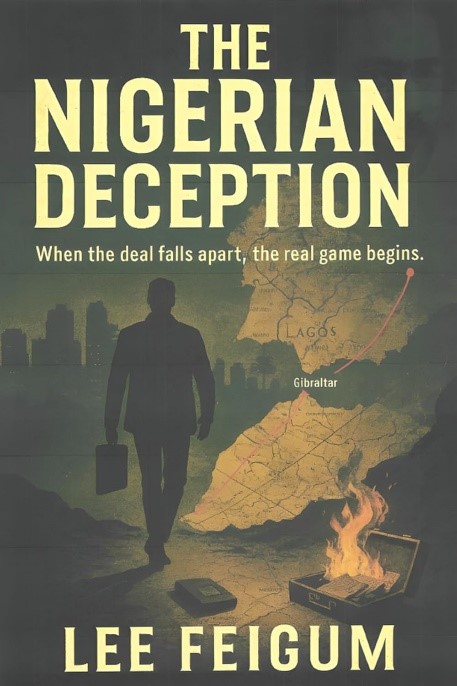
The Nigerian Deception is a remarkably immersive geopolitical thriller that distinguishes itself not only through its gripping narrative but through the authenticity and intelligence embedded within its storytelling. From the outset, Lee Feigum demonstrates a confident command of tone and structure, crafting a novel that feels less like fiction and more like a window into the hidden mechanics of international business, finance, and political maneuvering. The fact that the story is inspired by true events elevates its impact significantly, transforming each development into something that carries both narrative weight and real-world plausibility.
At the heart of the novel lies Carter Weston, a character whose journey is as compelling psychologically as it is narratively. Introduced as a capable and ambitious American businessman, Carter embodies the mindset of someone driven by opportunity and expansion. His decision to engage with what appears to be a transformative telecommunications project in Nigeria is rooted in logic, experience, and the promise of professional advancement. However, what makes his character particularly effective is the gradual unraveling of his confidence as he becomes aware of the deeper, more dangerous forces at play. Feigum does not rush this transformation. Instead, he allows Carter’s awareness to evolve naturally, capturing subtle shifts in perception, growing unease, and the instinctive realization that something is fundamentally wrong. This measured character development draws readers into Carter’s internal conflict, making his eventual fight for survival feel earned and deeply engaging.
The plot itself is constructed with precision and layered complexity. Feigum skillfully intertwines multiple elements, including offshore financial operations, corrupt governmental influence, and an intricate network of intermediaries operating within the shadows of global commerce. Each layer is revealed with careful timing, ensuring that the reader remains both informed and intrigued without ever feeling overwhelmed. The narrative maintains a delicate balance between clarity and mystery, allowing readers to piece together the larger conspiracy alongside the protagonist. This technique not only heightens suspense but also reinforces the novel’s realism, as the unfolding events mirror the often opaque nature of real-world international dealings.
One of the most striking aspects of the book is its setting, which serves as more than just a backdrop. Feigum brings locations to life with vivid detail and atmospheric depth, particularly in his portrayal of Lagos and its financial institutions. The corridors of power, the bureaucratic structures, and the subtle tensions within these environments are depicted with an authenticity that suggests firsthand understanding. This grounded depiction contrasts sharply with the intensity of later scenes, such as Carter’s desperate navigation through the streets and alleyways of Casablanca. The shift in setting mirrors the escalation of stakes, moving from calculated negotiations to raw survival, and this transition is handled with remarkable fluidity.
The pacing of the novel deserves particular recognition. Feigum exercises disciplined control over the rhythm of the story, allowing moments of tension to build gradually before releasing them in sequences of heightened action or revelation. Early chapters focus on establishing context and character, creating a solid foundation upon which the rest of the narrative is built. As the story progresses, the pacing accelerates in tandem with Carter’s growing awareness of danger. This escalation feels organic rather than forced, and it keeps readers consistently engaged. By the time the narrative reaches its most intense moments, the sense of urgency is palpable, and the stakes feel genuinely consequential.
Beyond its surface as a thriller, The Nigerian Deception offers a thoughtful exploration of ambition and its inherent risks. Feigum examines how the pursuit of success, particularly in unfamiliar or complex environments, can expose individuals to unforeseen vulnerabilities. Carter’s journey becomes a reflection of a broader truth: that opportunity and danger often exist in close proximity, and the line between them can be alarmingly thin. This thematic layer adds depth to the narrative, encouraging readers to reflect on the realities of global business and the unseen forces that can influence it.
The writing style is both refined and purposeful. Feigum demonstrates an ability to convey complex ideas without sacrificing readability, making the novel accessible to a wide audience while maintaining intellectual depth. His prose is clear and deliberate, avoiding unnecessary embellishment while still providing enough detail to create a vivid and immersive experience. Dialogue is used effectively to advance the plot and reveal character motivations, and it often carries an undercurrent of tension that reflects the high-stakes nature of the story.
Another noteworthy strength is the novel’s sense of realism. The integration of financial systems, political structures, and international relationships is handled with care, ensuring that the story remains believable even at its most intense moments. This realism is further reinforced by the author’s apparent familiarity with the subject matter, which lends credibility to every aspect of the narrative. Readers are not simply entertained; they are given insight into a world that is rarely seen but deeply influential.
Ultimately, The Nigerian Deception succeeds on multiple levels. It is a compelling thriller that delivers suspense and intrigue, a character-driven story that explores personal and psychological transformation, and a thought-provoking examination of the complexities of global ambition. Lee Feigum has crafted a debut that feels both confident and impactful, demonstrating a strong understanding of storytelling and an ability to engage readers with both narrative and substance.
This is a novel that leaves a lasting impression, not only because of its plot but because of the ideas it explores and the realism it maintains throughout. For readers seeking a thriller that goes beyond surface-level excitement and delves into the deeper dynamics of power, risk, and human decision-making, The Nigerian Deception stands as an exceptional and memorable work.
Readers interested in exploring the book further can grab their copy here: https://a.co/d/0dLlrZCQ.