
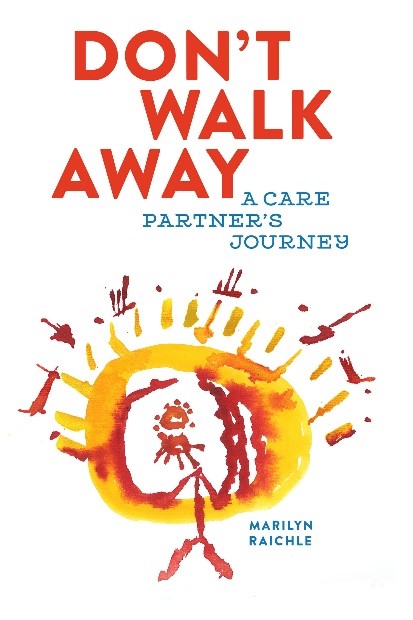
In a literary landscape often saturated with clinical discussions and distant observations about Alzheimer’s and dementia, Don’t Walk Away: A Care Partner’s Journey by Marilyn Raichle emerges as a profoundly human, deeply moving, and transformative work that redefines how we understand caregiving, connection, and the enduring essence of personhood. This is not simply a memoir, nor is it a guidebook in the traditional sense. It is, rather, a lived experience rendered with remarkable clarity, compassion, and wisdom—one that invites readers into an intimate space where love persists beyond memory, and presence transcends loss.
From the very foundation of the book, Raichle establishes a tone of authenticity that is both disarming and compelling. As seen in the early pages, particularly the introduction, the author openly acknowledges her initial fear, confusion, and misunderstanding of Alzheimer’s, admitting that she once saw only loss rather than the person within . This level of vulnerability immediately sets the stage for a narrative that is not about perfection or idealized caregiving, but about growth, learning, and transformation through lived experience. It is this honesty that becomes the heartbeat of the entire work.
The book’s structure itself mirrors the emotional and psychological journey of caregiving. As outlined in the table of contents on page 7, the progression from “Walk Away” to “Mom Begins to Paint / I Begin to Learn,” and eventually to “Life Gets Better,” reflects not only the stages of the author’s journey but also a profound philosophical shift in perspective. This is not a linear story of decline, as many might expect from a book about dementia. Instead, it is a story of rediscovery—of learning to see, to listen, and to connect in ways that transcend conventional communication.
One of the most powerful and unique elements of this book is its integration of art as both a narrative device and a therapeutic lens. The inclusion of Jean McFee Raichle’s paintings—referenced throughout the book and visually represented in multiple pages—serves as a symbolic and literal expression of the inner world of a person living with dementia. These artworks are not mere embellishments; they are essential to the storytelling. As explained in the note on the paintings (page 15), these creative expressions offer a window into thoughts and emotions that words can no longer convey. This artistic dimension elevates the book beyond a written narrative, transforming it into a multidimensional experience that engages both the intellect and the senses.
Raichle’s writing style is elegant in its simplicity. She avoids unnecessary complexity, allowing the emotional weight of her experiences to speak for itself. Yet within this simplicity lies a depth that is both philosophical and practical. The foreword emphasizes the concept of “I–Thou” relationships—a relational philosophy that underscores mutual presence and recognition rather than objectification. This concept becomes a guiding principle throughout the book, illustrating how caregiving, when approached with awareness and empathy, can become a shared journey rather than a one-sided burden.
Perhaps the most striking achievement of Don’t Walk Away is its ability to challenge deeply ingrained assumptions about dementia. Society often frames Alzheimer’s as a complete erasure of identity, reducing individuals to their symptoms. Raichle, however, dismantles this narrative with grace and conviction. Through her experiences with her mother, she reveals that while memory may fade, the core of a person—their capacity for joy, creativity, and connection—remains intact. This perspective is not only refreshing but profoundly necessary, offering a more humane and hopeful approach to understanding the condition.
The emotional resonance of the book is undeniable. There are moments of sadness, certainly, but they are balanced by moments of beauty, humor, and unexpected joy. The author recounts how painting became a bridge between her and her mother, transforming their relationship into one of shared presence and discovery. These moments are not presented as extraordinary exceptions but as accessible possibilities—reminders that meaningful connection is still achievable, even in the face of cognitive decline.
Another remarkable strength of the book lies in its dual purpose. On one level, it is a deeply personal narrative—a daughter’s journey with her mother through the complexities of Alzheimer’s. On another level, it functions as a guide for other caregivers, offering insights that are both practical and philosophical. The dedication page poignantly addresses both those at the beginning of their caregiving journey and those who may have already “walked away,” suggesting that it is never too late to reconsider and reconnect. This inclusive approach broadens the book’s impact, making it relevant to a wide audience.
Raichle also addresses the emotional toll of caregiving with honesty and sensitivity. She does not romanticize the experience or ignore its challenges. Instead, she acknowledges the difficulty while simultaneously offering a framework for navigating it with resilience and grace. This balance between realism and optimism is one of the book’s greatest strengths, ensuring that it remains both credible and inspiring.
The pacing of the narrative is deliberate and reflective, allowing readers to fully absorb each insight and experience. There is no rush toward resolution, no attempt to neatly tie together the complexities of caregiving into a simple conclusion. Instead, the book unfolds organically, mirroring the unpredictable and often nonlinear nature of life with dementia. This approach not only enhances the authenticity of the narrative but also invites readers to slow down and engage more deeply with the material.
By the time the reader reaches the later sections of the book, there is a clear sense of transformation—not only in the author’s perspective but also in the reader’s understanding. The journey that begins with uncertainty and fear evolves into one of acceptance, connection, and even gratitude. This transformation is not presented as a final destination but as an ongoing process, reinforcing the idea that caregiving is as much about personal growth as it is about supporting another.
The closing pages, including reflections on who the author’s mother was before Alzheimer’s, serve as a powerful reminder of the fullness of a life beyond the illness. These moments anchor the narrative in a broader context, ensuring that the individual is never defined solely by their condition. Instead, they are remembered in their entirety—complex, vibrant, and deeply loved.
In conclusion, Don’t Walk Away: A Care Partner’s Journey is an extraordinary work that transcends its subject matter to offer a universal message about love, presence, and the enduring nature of human connection. Marilyn Raichle has created a book that is as enlightening as it is moving, as practical as it is philosophical. It is a testament to the power of empathy and the profound impact of choosing to stay, to engage, and to see the person behind the diagnosis.
This is a book that deserves to be read not only by caregivers or those directly affected by dementia, but by anyone seeking a deeper understanding of what it means to truly connect with another human being. It is, without question, a significant and lasting contribution to both literature and the ongoing conversation about caregiving and humanity.
Readers interested in exploring the book further can grab their copy here: https://a.co/d/07laW8Q7