
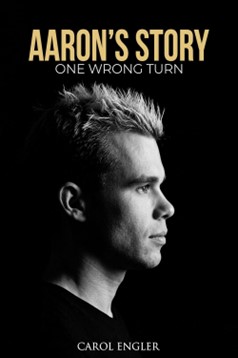
There are books that inform, books that entertain, and books that break the reader open with their honesty and refuse to let them look away. Carol Engler’s Aaron’s Story: One Wrong Turn belongs firmly in the third category. It is one of the most courageously written memoirs to emerge from the world of special needs parenting — a book that earns every laugh it generates and every tear it demands, a book written not from a safe distance of resolved grief but from the still-raw, still-questioning heart of a mother who loved her son ferociously, fought for him relentlessly, and lost him anyway at twenty-five years old on a Thursday night in April 2012, three-tenths of a mile from her front door.
Carol Engler was, before she became a real estate agent, an award-winning newspaper reporter, and that training is evident on every page. She writes with the instinct of a journalist for the telling detail, the precisely observed scene, and the frank assessment that does not flinch from uncomfortable truths. She also writes with the voice of a Jewish mother from Yuma, Arizona — large-hearted, self-deprecating, relentlessly funny even in the middle of catastrophe — and that voice is one of the most distinctive and endearing in contemporary memoir. Within the first few pages, in which she describes negotiating a real estate contract while in active labour and threatening her client that the baby would be born right there in the office unless the paperwork was signed immediately, she has the reader entirely in her hands, and she never lets go.
Aaron Casey Engler entered the world on August 1, 1986, at just under ten pounds, with, as his father Don observed, enormous paws and the air of a man who had arrived somewhere important. He was also, as his mother would come to understand over the painful years that followed, a child whose brain worked in ways that none of the doctors he saw for years — allergists, pediatricians, psychiatrists, psychologists, social workers across three different states — could diagnose or even properly name. It was a niece who finally identified it, not from a textbook but from recognizing in Aaron the same quirks she had observed in her boyfriend Bobby: Tourette Syndrome. A library visit confirmed what the medical profession had missed, and from that moment forward Carol became something she had not been before, or rather became the fullest expression of something she had always been — an unstoppable, encyclopaedic, occasionally terrifying advocate for her son and for every child like him in her community and beyond.
The portrait of Aaron that emerges across the book’s fifty chapters is one of the most complex, loving, and ultimately heartbreaking character studies in recent memoir. He is simultaneously a source of chaos and a source of joy, a manipulator and a gentle giant, a child whose frontal lobes — as his grandfather perfectly described it — contained scrambled eggs, and a young man who could calmly approach a terrified newborn colt separated from its mother, speak to it softly, wrap his enormous arms around it, and carry it safely back to its stall, leaving his mother standing in stunned silence with a feather that could knock her over. He is the boy who had forty Hasbro GI Joes delivered to the house after Carol’s magnificently scathing complaint letter, and who had destroyed every single one of them by the following afternoon, explaining each incident — the smashed dolls, the destroyed brick barbecue, the entire collection of Kachina Doll decanters full of liquor running down the driveway — with the same perfectly clear response: “My brain made me do it.” He is the teenager who accessed a porn site in under two minutes during a PTA meeting specifically designed to demonstrate the safety of school computers, causing the school district to abandon its entire software purchase. He is the young man who turned up at Carol and Mike’s house on the night of his death to beg for groceries, loading up bags of spaghetti sauce, peanut butter, cookies, and an open carton of milk, and receiving from his mother the instruction to buckle the milk carton in with a seatbelt so it would arrive home safe. She pushed him out the door with “I love you, bunches.” It was the last thing she ever said to him.
Engler does not spare herself in this account. She writes with bracingly honest self-examination about her own Tourette’s traits — identified at a conference in Burbank when a stranger asked her, not unkindly, what she was doing about her own Tourettes, and she walked away in a fury before her twin sister Roni talked her down that night and they both acknowledged the mouth twitching, the hyperactivity, the OCD rituals that had been present in their family for generations. She writes about her husband Don’s years of denial — twenty-five years living, in her phrase, “in Egypt on the River Denial,” insisting that Aaron was “all boy,” making teachers cry, refusing treatment, calling the Intervention television show’s producer and threatening legal action when Carol had arranged for Aaron to receive help at the Betty Ford Centre, a decision that she believed, and states unambiguously, signed her son’s death warrant six months before he died. She writes about her own moments of cruelty born of desperation, the furious emails and the times her reserves ran entirely out. And she writes about the genuine love that never wavered — through ninety-nine emergency room visits in three months, through the motorcycles Don bought against her express wishes, through the bulimia and the cutting and the overdoses and the residential treatment centres, through all of it, the love remained.
The advocacy sections of the book are among its most powerful and most practically useful. Engler did not confine her hard-won knowledge to her own household. She started a Tourette’s support group in Yuma when there was none. She became the go-to mother for every parent whose child had an unexplained tic or a behavioural disorder the school system could not accommodate. She bought a car for a single mother of a non-verbal, unvaccinated, profoundly autistic child who had been turned away from services, personally paid for the boy’s first medical evaluation, and drove to Phoenix to sit outside the Department of Developmental Disabilities until the right person agreed to listen — at which point the boy was approved for services before she even left the car park. She flew a boy named Johnny to the Meridell Achievement Centre in Austin, Texas, where Aaron himself had once been treated, and he went on to graduate from school without further incident. She fought until a school district apologized to a child with Tourette’s who had been arrested for slapping a teacher’s hand when the teacher refused to let him go to the bathroom despite it being written into his Individualized Education Plan. Her chapter on practical strategies for parents and teachers of Tourette’s children — the mousepad under the pencil to muffle tapping, the laminated shower checklist hung on the showerhead, the invented word Farganizel to replace involuntary profanity, the instruction never to say don’t because the brain only hears the verb — is worth the price of the book on its own for any parent navigating a similar path.
The grief chapters that follow Aaron’s death on April 19, 2012, are written with a restraint that makes them even more devastating. Engler describes packing books and phone chargers and snacks on the way to the hospital because she and Mike had done that drill so many times before it barely registered. She describes driving past the crash site — Aaron’s Honda Civic embedded in a concrete power pole three-tenths of a mile from her front door — and barely noticing it, so accustomed had she become to emergencies. She describes being led to the private locked room in the emergency department, which she now advises every reader to turn around and run from if they ever find themselves in one. She describes Don asking the doctor, “Are you sure?” She describes calling her twin sister Roni and saying only, “Aaron is dead,” and the silence that followed. She describes not being able to cry, not being able to think, grateful that breathing is involuntary because even that was a chore.
The funeral that Carol assembled for Aaron — a Jewish service in a city with no rabbi, managed through a chain of phone calls that somehow reached a cantor named Liat Hoffman who interrupted her five-day-old honeymoon to fly to Yuma on a rubber-band prop plane — is one of the most moving sequences in the book. The tributes read there capture what Engler has been showing the reader across two hundred pages: that Aaron, for all his chaos and his scrambled eggs for brains and his ninety-nine emergency room visits, had the biggest heart in any room he entered, that he never said goodbye without an I love you and a bear hug, that his apartment on First Avenue had a revolving door and people sleeping on every available surface including, as one speaker noted, the ceiling. His legacy is the Aaron Casey Engler Memorial Scholarship at Arizona Western College, funding students going into mental health — the field he had been accepted into, with a seventeen-thousand-dollar Pell Grant, on the last day of his life.
Aaron’s Story: One Wrong Turn is a book that will matter enormously to parents of children with special needs, to anyone who has loved a mentally ill person, to anyone who has struggled to navigate the overlapping failures of the medical, educational, and social welfare systems on behalf of someone they cannot stop fighting for, and to anyone who has experienced the particular devastation of a grief you saw coming and still could not prevent. Carol Engler has written it with the full force of a mother’s love and a journalist’s discipline, and the result is a book that is essential, unforgettable, and, in the end, despite everything, a tribute worthy of the big-hearted, scrambled-eggs-brained, food-obsessed, computer-gaming, bear-hugging gentle giant it was written to honour.