
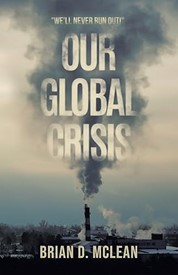
Brian D. McLean’s Our Global Crisis is a sweeping, urgent, and intellectually ambitious examination of humanity’s present condition, written with the gravity of a warning and the breadth of a civilizational study. The book arrives at a moment when questions about climate change, environmental degradation, overconsumption, social fragility, and the future of global society are no longer speculative concerns but immediate realities pressing upon every nation, economy, and generation. McLean does not approach these issues as isolated policy problems. He treats them as symptoms of something deeper — a recurring weakness in human societies that has appeared before, in civilizations once thought secure, and may now be threatening the survival of our own.
The central premise of Our Global Crisis is stark and sobering: modern society has reached a critical juncture. Like the Incas, the Mayans, the Romans, the Rapanui, and other civilizations that rose to extraordinary heights before collapsing under the weight of internal and external pressures, our own global civilization may be more vulnerable than it appears. McLean’s comparison to past societies is not offered as casual historical decoration. It is the foundation of the book’s warning. Civilizations do not collapse simply because they are weak. They often collapse after long periods of apparent strength, prosperity, complexity, and confidence. That is what makes the book’s argument so unsettling. It asks whether our greatest achievements may also be concealing our deepest risks.
What gives the book its force is McLean’s refusal to let the reader remain comfortable. Our Global Crisis is not merely about environmental damage, though climate change and ecological disruption occupy a central place in its argument. It is about the human systems, instincts, and collective habits that have brought us to this point. The book suggests that even if humanity were able to mitigate or repair the most visible environmental threats, a larger danger would remain unless we confront the underlying source of the crisis. That source, as McLean frames it, lies in the relationship between human nature, consumption, survival instincts, social organization, and the limits of the planet that supports us.
This makes Our Global Crisis more than an environmental book. It is also a book about psychology, history, civilization, economics, and moral responsibility. McLean appears especially interested in the patterns that repeat across time: societies expand, consume, organize themselves around growth, and often fail to recognize the danger until the systems they depend upon are already under severe strain. His work invites readers to see the present not as an unprecedented exception, but as part of a recurring civilizational pattern. The difference, of course, is scale. Earlier collapses were regional. Ours would be planetary.
The book’s treatment of climate change and environmental degradation is appropriately grave. McLean presents these threats as forces capable of damaging coastal cities, island nations, agricultural systems, biodiversity, and the global economy. The language of the book is not alarmist in the shallow sense; rather, it is alarmed because the subject demands alarm. There is a difference between panic and clear-eyed urgency, and Our Global Crisis belongs to the latter category. It insists that the consequences of inaction are not abstract. They involve real communities, real ecosystems, real economies, and real lives.
Yet the book’s most valuable contribution may be its insistence that analysis alone is not enough. Many books diagnose the condition of the planet; fewer are willing to ask what must change in human behavior, collective priorities, and social organization if survival is to remain possible. McLean’s final chapter, dedicated to practical solutions, gives the work an important structural balance. The book does not end by leaving readers in despair. It argues that the crisis can only be addressed if humanity recognizes the scale of the danger and responds with discipline, clarity, and a willingness to change. The solutions may be simple in principle, but they are difficult because they require a transformation in collective will.
The critical praise surrounding Our Global Crisis is not surprising. Descriptions such as “a wake-up call to humanity,” “a valuable tool for determining solutions critical for survival,” and “a comprehensive and fascinating study of the state of the planet” reflect the book’s broad ambition and serious purpose. The work seems to have earned attention precisely because it refuses to narrow the crisis into a single issue. Instead, McLean examines the planet through a wide lens, connecting sustainability, survival instincts, consumption, environmental decline, and the precarious systems that underpin modern life. This breadth gives the book its intellectual weight.
One of the strongest aspects of the book is its historical consciousness. By invoking collapsed civilizations, McLean reminds readers that human societies are not guaranteed permanence. The Roman Empire, the Mayan civilization, the Rapanui of Easter Island, and other societies each possessed forms of knowledge, organization, and cultural confidence. Yet none were immune to decline. This historical perspective gives the book a necessary humility. It challenges the modern assumption that technological advancement alone will save us. Technology may be powerful, but if it is governed by the same destructive appetites and short-term thinking that created the crisis, it may only delay the reckoning rather than prevent it.
The book also appears to understand that the global crisis is not only environmental but moral. The damage humanity has done to the planet reflects choices — repeated, defended, normalized choices — about consumption, convenience, wealth, growth, and responsibility. McLean’s argument pushes readers to consider the ethical cost of living as though the future were an inexhaustible resource. This is where the book becomes most challenging. It does not allow readers to think of the crisis as something caused only by governments, corporations, or distant systems. Those forces matter enormously, but they exist within a larger human pattern. The crisis is structural, but it is also behavioral.
Our Global Crisis is especially compelling because it treats survival as both a practical and philosophical question. What does it mean for humanity to survive? Is survival merely the continuation of industrial society in a slightly cleaner form, or does it require a deeper reconsideration of how we define progress? Must prosperity always mean expansion? Must success always mean more extraction, more consumption, more production, more speed? These are the kinds of questions that give the book its depth. McLean’s work is not only asking how we can avoid collapse. It is asking what kind of civilization deserves to continue.
The prose, as suggested by the book’s reception, appears dense but engaging — the kind of writing suited to a subject that demands seriousness. A work of this scope cannot responsibly be reduced to slogans. It must gather evidence, trace patterns, weigh implications, and connect large systems without losing the reader’s attention. McLean’s book seems to do precisely that. It is comprehensive without being merely encyclopedic, urgent without being careless, and analytical without losing sight of the human stakes.
The phrase “global crisis” is sometimes used so often that it begins to lose meaning. McLean restores its weight. In his hands, the term does not refer to one emergency but to a convergence of emergencies: environmental instability, civilizational vulnerability, ecological decline, economic exposure, human overconsumption, and the deeper instincts that make societies slow to change even when danger is visible. That convergence is what makes the book necessary. The danger is not one storm, one policy failure, one species lost, one city flooded, or one economy strained. The danger is the pattern that connects them.
Readers who come to Our Global Crisis looking for easy reassurance will not find it. This is not a book designed to flatter humanity. It is designed to confront it. But that confrontation is precisely what gives the work its value. McLean writes from the premise that survival depends first on honest recognition. A civilization cannot solve problems it refuses to name. It cannot change course while pretending the road ahead is safe. It cannot continue confusing temporary prosperity with long-term viability.
The book will appeal to readers interested in environmental studies, sustainability, history, social collapse, global systems, human behavior, and the future of civilization. It will also be valuable for those who want a broad, integrated view of the challenges facing humanity rather than a narrow treatment of climate or ecology alone. McLean’s approach is particularly useful because it places today’s crisis within a larger human story. We are not the first society to face limits. We may, however, be the first to face them on a planetary scale.
By the end, Our Global Crisis leaves the impression of a work written with urgency, discipline, and moral seriousness. Brian D. McLean has produced a book that is both diagnosis and warning, both historical reflection and survival argument. It asks readers to look beyond the immediate symptoms of climate change and environmental decline toward the deeper habits that produced them. It reminds us that civilizations can fail, that complexity does not guarantee wisdom, and that the future of modern society is not assured simply because we believe ourselves advanced.
Most importantly, the book insists that solutions remain possible only if humanity is willing to confront the truth of its condition. Our Global Crisis is not comfortable reading, but it is important reading. It is a sobering, comprehensive, and timely call to awareness — a book that challenges readers to understand not only what is happening to the planet, but what must change within us if we are to have any serious hope of preserving it. Readers interested in exploring the book further can find it here:
https://a.co/d/0iEZ5YMm