
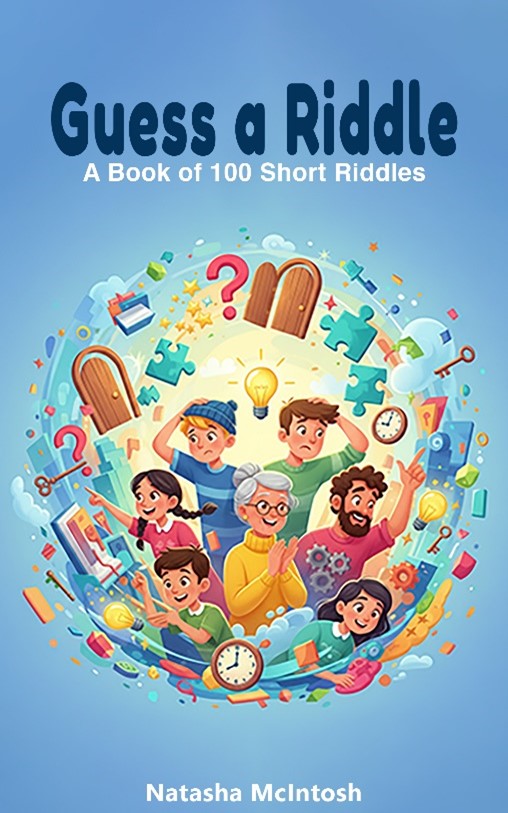
Guess a Riddle: A Book of 100 Short Riddles by Natasha McIntosh is an exceptionally engaging and thoughtfully crafted collection that successfully blends entertainment, imagination, and intellectual stimulation into one delightful experience. From the very first pages, it becomes clear that this book is far more than a simple compilation of riddles—it is a vibrant invitation into a world of curiosity, laughter, and shared moments of discovery.
At its core, this book thrives on its universal appeal. Designed for both children and adults, it effortlessly bridges generational gaps, creating a shared space where families, friends, and even educators can come together to engage in meaningful and enjoyable mental challenges. As noted in the introduction, the book is intended to “spark laughter among family, friends, neighbors, and other associates,” while also enhancing problem-solving and critical-thinking skills . This dual purpose—entertainment and cognitive development—is executed with remarkable balance throughout the entire collection.
One of the most striking strengths of this book lies in its simplicity combined with depth. Each riddle is concise, yet thought-provoking, encouraging readers to pause, reflect, and explore different perspectives. The questions range from playful and imaginative to subtly philosophical, making the reading experience dynamic and continuously engaging. For instance, riddles such as “What comes back around like a boomerang?” and “What can spread and poison a person?” immediately draw readers in with their layered meanings, prompting both logical reasoning and creative thinking as seen on the early pages of the book . This variety ensures that the book never feels repetitive; instead, it maintains a steady rhythm of intrigue and surprise.
Another standout element is the book’s visual presentation. The inclusion of colorful and imaginative illustrations alongside the riddles significantly enhances the overall experience. These visuals are not merely decorative—they actively contribute to the storytelling aspect of each riddle. As seen across multiple pages, such as pages 7 through 14, the artwork complements the questions by providing subtle clues or thematic context, enriching the reader’s engagement. The illustrations transform the riddles into mini visual puzzles, making the book especially appealing for younger audiences while still maintaining depth for older readers.
The structure of the book is also commendable. With 100 riddles carefully organized and followed by a comprehensive answer section, readers are given the freedom to engage at their own pace. The answer sheet, located toward the end of the book, allows readers to test their understanding without immediate interruption, fostering a sense of accomplishment when answers are correctly guessed. This thoughtful arrangement encourages independent thinking before verification, reinforcing the book’s educational value.
What truly elevates Guess a Riddle is its ability to stimulate multiple areas of the mind simultaneously. The riddles encourage lateral thinking, pattern recognition, language comprehension, and abstract reasoning. Questions such as “What can be hidden but also revealed?” or “What wanders and sometimes causes daydreams?” challenge readers to go beyond surface-level thinking and explore deeper interpretations. This makes the book not only entertaining but also intellectually enriching.
Additionally, the book excels in its versatility. It is not limited to solitary reading; rather, it shines in group settings. Whether used during family gatherings, classroom activities, sleepovers, or casual social events, the riddles naturally create interaction and dialogue. The introduction highlights its suitability for various settings, including camping trips and group activities, emphasizing its role as a social catalyst . This adaptability makes it a valuable addition to any household or educational environment.
The tone of the book is another noteworthy aspect. It maintains a light, playful, and inviting atmosphere throughout, ensuring that readers feel encouraged rather than intimidated. Even when a riddle proves challenging, the experience remains enjoyable rather than frustrating. This balance is particularly important in maintaining reader engagement across different age groups and skill levels.
Furthermore, the thematic diversity within the riddles adds an extra layer of richness to the book. The questions touch on everyday objects, natural phenomena, emotions, abstract concepts, and even moral ideas. For example, riddles exploring concepts like truth, destiny, time, and ego introduce subtle philosophical undertones, allowing readers to reflect on deeper meanings while still enjoying the playful format. This blend of simplicity and depth is a testament to Natasha McIntosh’s creativity and thoughtful approach to content creation.
The inclusion of answers at the end of the book also demonstrates a strong understanding of reader experience. By placing the solutions separately, the author preserves the integrity of the challenge while still providing closure and clarity. This design choice enhances the overall satisfaction of solving each riddle and encourages readers to revisit the book multiple times.
Another remarkable quality of this book is its ability to inspire curiosity. Each riddle acts as a small spark, igniting the reader’s imagination and encouraging them to think beyond conventional boundaries. This sense of curiosity extends beyond the pages of the book, influencing how readers approach everyday questions and observations. It subtly trains the mind to look for connections, patterns, and hidden meanings in the world around them.
In conclusion, Guess a Riddle: A Book of 100 Short Riddles by Natasha McIntosh is a beautifully crafted, highly engaging, and intellectually stimulating collection that delivers on every level. It successfully combines entertainment, education, and creativity, making it a standout addition to the genre. With its thoughtful structure, captivating illustrations, and diverse range of riddles, the book offers a rich and rewarding experience for readers of all ages.
This is not just a book of riddles—it is an experience that brings people together, challenges the mind, and celebrates the joy of thinking. Readers interested in exploring the book further can grab their copy here: https://a.co/d/0cJlhUyJ