
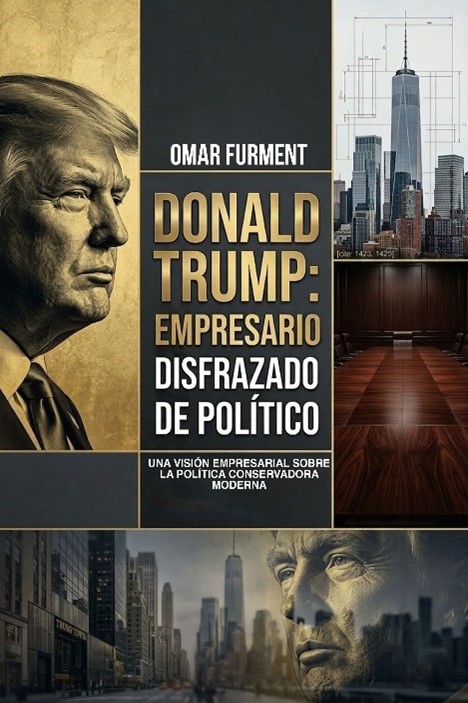
Donald Trump: Empresario Disfrazado de Político by Omar Furment is a bold, intellectually engaging, and sharply observed work that offers readers a compelling lens through which to examine one of the most polarizing figures of modern times. Rather than approaching Donald Trump through the conventional frameworks of political commentary or partisan critique, Furment crafts a narrative that situates Trump firmly within the context of business psychology, branding strategy, and entrepreneurial mindset—arguing, with notable clarity and conviction, that Trump’s political identity cannot be fully understood without first recognizing the businessman behind the public persona.
From the very beginning, the book establishes a strong and unapologetic thesis: that Donald Trump operates not as a traditional politician molded by ideology or public service, but as an empresario—a businessman whose instincts, decisions, and public strategies are deeply rooted in the logic of deal-making, negotiation, and brand dominance. This framing alone sets the book apart from the vast majority of literature written about Trump, offering a fresh and thought-provoking perspective that feels both original and intellectually stimulating.
One of the most compelling aspects of Furment’s work is the analytical depth with which he dissects Trump’s behavior, communication style, and leadership approach. The author demonstrates a keen understanding of how business principles translate into the political arena, drawing parallels between corporate strategy and governmental decision-making in a way that feels both insightful and accessible. Rather than relying on sensationalism or emotional rhetoric, Furment adopts a measured, almost clinical tone, allowing readers to engage with the material critically and independently. This restraint adds credibility to the work, making it feel less like an opinion piece and more like a structured analysis grounded in observation and reasoning.
The book excels in its exploration of branding—arguably one of Trump’s most defining strengths. Furment delves into how Trump has meticulously crafted and maintained a personal brand that transcends traditional political boundaries. He examines the use of media, messaging, and public perception as tools not merely for communication, but for influence and control. In doing so, the author reveals how Trump’s approach to politics mirrors the strategies employed by high-level entrepreneurs: identifying opportunities, leveraging attention, and consistently reinforcing a recognizable and dominant identity. This section of the book is particularly enlightening, as it encourages readers to view political leadership through the often-overlooked lens of brand architecture.
Another notable strength of the book lies in its ability to contextualize Trump’s actions within a broader framework of entrepreneurial thinking. Furment argues that many of Trump’s most controversial decisions can be better understood when viewed as calculated risks—moves that, while unconventional in the political sphere, are entirely consistent with business practices aimed at maximizing impact and visibility. This perspective does not necessarily seek to justify or criticize these decisions, but rather to interpret them in a way that adds nuance to the conversation. It is this commitment to analysis over judgment that gives the book its intellectual weight.
The writing style itself is both engaging and accessible, striking a careful balance between academic rigor and readability. Furment avoids overly complex language, opting instead for clear and concise explanations that make the material approachable for a wide audience. At the same time, the book does not sacrifice depth, maintaining a level of sophistication that will appeal to readers interested in political science, business strategy, and leadership studies. This dual appeal is a testament to the author’s skill in communicating complex ideas without alienating the reader.
Emotionally, the book maintains a deliberate distance, focusing more on interpretation than reaction. While this may initially feel restrained, it ultimately serves to strengthen the work’s credibility. By avoiding overt emotional bias, Furment allows readers to form their own conclusions, creating a more interactive and intellectually honest reading experience. This approach is particularly valuable in a subject matter that is often dominated by strong opinions and polarized viewpoints.
Structurally, the book is well-organized, with each chapter building logically upon the last. The progression of ideas feels intentional and coherent, guiding the reader through a layered understanding of Trump’s persona. The pacing is steady, allowing for reflection without becoming sluggish, and the transitions between topics are smooth and well-executed. This structural clarity enhances the overall reading experience, making the book both engaging and easy to follow.
It is worth noting that the book’s focused lens—viewing Trump primarily as a businessman—may leave some readers wishing for a more comprehensive exploration of his political ideology or policy decisions. However, this is less a limitation and more a deliberate choice on the part of the author. By narrowing the scope, Furment is able to provide a more detailed and cohesive analysis, avoiding the dilution that often comes with attempting to cover too many angles. The result is a work that is both focused and impactful.
Another subtle strength of the book is its ability to challenge preconceived notions. Regardless of the reader’s personal views on Donald Trump, Empresario Disfrazado de Político encourages a reconsideration of how leadership is defined and understood. It prompts readers to question whether traditional political frameworks are sufficient for analyzing modern figures who operate outside established norms. This intellectual provocation is one of the book’s most valuable contributions, as it extends the conversation beyond Trump himself to broader questions about power, influence, and the evolving nature of leadership in the 21st century.
The concluding sections of the book are particularly effective, synthesizing the key arguments into a cohesive and thought-provoking reflection. Furment does not attempt to provide definitive answers or final judgments; instead, he leaves the reader with a framework for continued analysis. This open-ended conclusion reinforces the book’s analytical nature, emphasizing that understanding a figure as complex as Donald Trump requires ongoing examination rather than simplistic categorization.
In conclusion, Donald Trump: Empresario Disfrazado de Político by Omar Furment is a highly compelling and intellectually rigorous work that offers a unique perspective on a widely discussed figure. Through its focus on business psychology, branding, and entrepreneurial strategy, the book provides valuable insights that go beyond conventional political analysis. It is a work that challenges, informs, and engages, making it a worthwhile read for anyone interested in understanding the intersection of business and politics.
For readers seeking a nuanced and thought-provoking exploration of leadership in the modern era, this book stands as a strong recommendation. It is not simply a commentary on Donald Trump, but a broader examination of how power can be shaped, perceived, and exercised in ways that defy traditional expectations.
Readers interested in exploring the book further can grab their copy here: https://a.co/d/07jvx5ER