
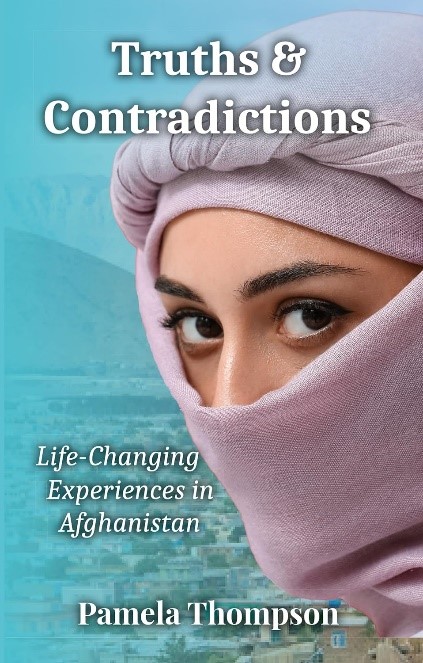
Pamela Thompson’s Truths & Contradictions: Life-Changing Experiences in Afghanistan is a thoughtful, courageous, and deeply human work that brings together personal testimony, cultural reflection, leadership wisdom, and the hard-earned lessons of living and working in one of the world’s most complex environments. It is not simply a travel memoir, nor is it a conventional leadership book built around abstract principles. It is a work shaped by lived experience — by uncertainty, displacement, service, listening, and the moral challenge of trying to make a meaningful contribution in a place too often reduced to headlines, assumptions, and political simplifications.
At the heart of the book is Afghanistan, not as an idea, not as a symbol, and not as a distant crisis, but as a living country populated by men and women of courage, complexity, faith, grief, resilience, and contradiction. Thompson writes from the perspective of someone who entered the country not merely as an observer, but as a professional working within a critical public institution. As a consultant to the Ministry of Public Health, she helped support the development of Afghanistan’s first strategic plan, a role that placed her inside the practical realities of rebuilding, planning, leading, and collaborating amid uncertainty. That professional experience gives the book a seriousness that distinguishes it from more casual accounts of life abroad.
The title, Truths & Contradictions, is especially well chosen. Afghanistan is often discussed through fixed narratives: war, oppression, extremism, occupation, poverty, danger. Thompson does not deny the difficulties, but she appears determined to complicate them. The truth of Afghanistan, as this book suggests, cannot be contained in one story. It is a place of suffering and hospitality, restriction and resilience, tradition and change, fear and generosity, loss and extraordinary human strength. The contradictions are not weaknesses in the narrative; they are the narrative. They reveal the author’s willingness to look carefully, to resist easy judgment, and to allow complexity to remain complexity.
One of the book’s most important qualities is its blend of personal growth and cultural insight. Thompson does not position herself as someone who arrives with all the answers. Instead, she presents Afghanistan as a place that challenged, changed, and taught her. This is crucial. The best books about cross-cultural experience are not written from a posture of superiority, but from humility. Thompson’s work seems rooted in the understanding that entering another country, especially one shaped by conflict and political upheaval, requires listening before interpretation. It requires noticing not only what is broken, but what is strong. It requires seeing people as whole human beings rather than representatives of a crisis.
The leadership dimension of the book is also compelling because it emerges from real pressure. Leadership in stable environments is difficult enough; leadership in conflict-affected environments demands a different kind of clarity. Plans must be made amid uncertainty. Trust must be built across cultural, institutional, and political differences. Communication must be careful, respectful, and adaptive. Thompson’s experience in Afghanistan gives her insights into leadership that are grounded in reality rather than theory. She understands that leading through change is not about controlling every variable. It is about remaining purposeful when control is limited, staying open when assumptions fail, and making decisions in conditions where perfect certainty never arrives.
For readers navigating their own crossroads, this gives the book practical relevance beyond Afghanistan itself. Many people feel restless, unfulfilled, or unsure of their next steps. They may not be living in a conflict zone, but they may still be facing personal upheaval, career transition, grief, burnout, uncertainty, or the need to redefine purpose. Thompson uses her experiences in Afghanistan to speak to those broader human questions. How does one find clarity in chaos? How does one stay strong when familiar structures disappear? How does one contribute meaningfully when the scale of the problem feels overwhelming? These questions give the book its universal reach.
A particularly meaningful aspect of Truths & Contradictions is its attention to Afghan women and girls. Thompson’s book appears to recognize both their vulnerability and their strength. Too often, discussions about Afghan women are framed only through victimhood, while ignoring their agency, intelligence, leadership, courage, and persistence. Thompson’s approach seems more balanced and more respectful. She invites readers to understand the realities women and girls face, while also recognizing the resilience and dignity with which many navigate those realities. This is an important distinction. Compassion without respect can become condescending; Thompson’s work appears to aim for both.
The book also offers readers a chance to reconsider assumptions about Islam, Afghans, and Afghanistan. This is one of its most valuable contributions. In public discourse, especially outside the region, Afghanistan is frequently filtered through fear or political shorthand. Thompson’s book seems to push against that flattening. By exploring truths and contradictions around faith, culture, history, and daily life, she encourages readers to move beyond simplistic conclusions. That kind of cultural work matters. Understanding does not require romanticizing. It requires patience, context, and the willingness to see what does not fit one’s prior assumptions.
The historical dimension adds further depth. Afghanistan’s present cannot be understood without reference to the events, conflicts, invasions, traditions, and political shifts that have shaped its people. Thompson’s inclusion of key historic events helps readers situate personal stories within a larger national context. This makes the book more than a personal narrative. It becomes a bridge between memoir and public history, between individual transformation and collective experience. Readers unfamiliar with Afghanistan will likely find this especially useful, because it provides context without turning the book into a detached academic survey.
What makes Thompson’s perspective particularly effective is her background as a leadership and transition coach and consultant. She brings to the page an awareness of change as both an external and internal process. Transition is not merely moving from one job, country, or phase of life to another. It is the reorganization of identity. It asks people to examine what they value, what they fear, what they are willing to release, and what kind of contribution they hope to make. Afghanistan becomes, in this sense, both a literal setting and a profound classroom. It teaches Thompson about uncertainty, courage, humility, service, and purpose.
The book’s emotional appeal lies in its promise that meaningful change is possible even when the world feels unstable. Thompson does not appear to offer superficial encouragement. Instead, she offers the kind of inspiration that comes from having stood inside difficulty and continued anyway. There is a difference between optimism and resilience. Optimism hopes conditions will improve. Resilience learns how to move with strength even when conditions remain difficult. Truths & Contradictions seems to belong to the second category. It invites readers to cultivate inner steadiness rather than wait for life to become predictable.
The phrase “life-changing experiences” is not used lightly here. Afghanistan appears to have changed Thompson not only professionally, but personally and spiritually. Living and working in a challenging environment can strip away illusion. It can reveal one’s assumptions, privileges, limitations, and capacity for courage. It can also awaken a deeper sense of purpose. Thompson’s book seems to trace that transformation with honesty, showing how service in a difficult place can become a mirror for one’s own life. The reader is invited to ask: What am I being called to do? What change am I resisting? Where can I contribute? What does meaningful leadership look like in my own circumstances?
The writing, based on the book’s premise, seems designed for readers who want both story and application. It is not enough to describe Afghanistan; Thompson wants the reader to grow from the encounter. This gives the book a strong practical thread. Readers are offered tools to navigate challenges, gain clarity, and lead with confidence. The emphasis on tools is important because inspiration alone can fade quickly. A transformative book must help readers translate insight into action. Thompson’s work appears to do this by connecting the lessons of Afghanistan to the personal and professional crossroads many readers face.
Truths & Contradictions will likely resonate especially with women navigating major transitions, leaders working through uncertainty, coaches, consultants, nonprofit professionals, global development workers, and readers interested in Afghanistan beyond the usual headlines. It will also speak to anyone drawn to stories of courage in difficult environments. The book offers not only a window into Afghanistan, but a framework for thinking about how human beings find direction when life becomes unfamiliar.
One of the most admirable qualities of the book is its refusal to separate purpose from service. In many personal growth books, purpose is treated as something one discovers privately, almost as a form of self-fulfillment. Thompson’s experience suggests a wider understanding. Purpose becomes clearer when it is connected to contribution. It emerges when a person asks not only “What do I want?” but “Where can I be useful?” and “How can my skills meet a real need?” This service-oriented vision gives the book moral substance.
The book also appears to challenge readers to consider their role in improving the situation for women and girls in Afghanistan. This is a significant invitation. It moves the reader from awareness to responsibility. Learning about suffering is not the same as responding to it. Thompson seems to ask readers to think about how concern can become action, how empathy can become advocacy, and how global awareness can be translated into meaningful support. That makes the book timely and necessary.
By the end, Truths & Contradictions leaves the impression of a work written with intelligence, humility, and a sincere desire to help readers see more clearly — both Afghanistan and themselves. Pamela Thompson has created a book that blends memoir, leadership reflection, cultural insight, and personal transformation in a way that feels grounded and purposeful. It is a book about Afghanistan, but it is also a book about courage, uncertainty, change, and the search for meaningful contribution.
For readers seeking clarity, purpose, and a deeper understanding of how to lead through challenging circumstances, Truths & Contradictions offers both inspiration and guidance. It reminds us that the most difficult environments can become places of profound learning, that contradictions often reveal deeper truths, and that meaningful change begins when we are willing to step beyond comfort, listen carefully, and serve with courage.
Readers interested in exploring the book further can find it here:
https://a.co/d/0ea0N0IZ