
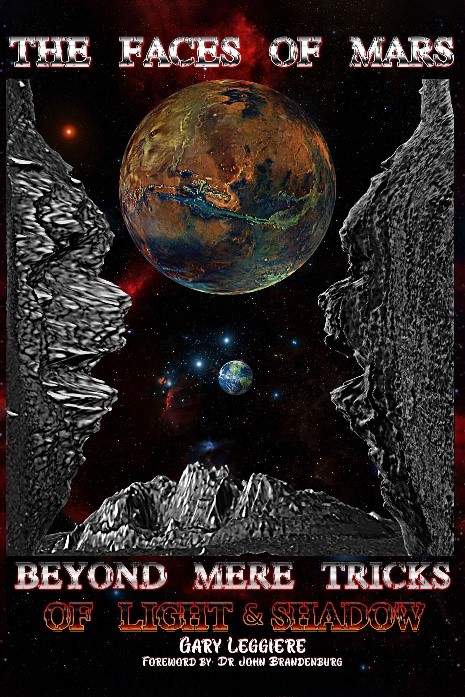
The Faces of Mars: Beyond Mere Tricks of Light and Shadow by Gary Leggiere is a compelling and intellectually provocative work that boldly revisits one of the most enduring and controversial mysteries in modern space exploration. Rather than accepting widely circulated conclusions at face value, Leggiere invites readers into a deeply researched and thoughtfully constructed investigation that challenges assumptions and reopens a debate many believed had long been settled. With contributions from Richard C. Hoagland and a foreword by John Brandenburg, the book carries a sense of authority and seriousness that immediately sets it apart within the genre.
From the outset, the narrative establishes itself as more than a simple recounting of the famous Cydonia “Face on Mars.” Instead, it presents a layered exploration of the historical, scientific, and cultural dimensions surrounding the phenomenon. Leggiere carefully reconstructs the timeline beginning with the original 1976 Viking images, offering readers a clear understanding of how the discovery captured global attention and sparked decades of speculation. This historical grounding provides a strong foundation upon which the rest of the investigation is built, allowing readers to appreciate both the evolution of the debate and the significance of the evidence presented.
One of the most impressive aspects of the book lies in its meticulous analysis of photographic data across multiple Mars missions. Drawing from imagery captured by Viking, Mars Global Surveyor, Mars Express, and the Mars Reconnaissance Orbiter, Leggiere examines how different processing techniques can dramatically alter interpretation. The comparisons between officially released images and carefully enhanced versions are presented with clarity and precision, encouraging readers to question how visual data is interpreted and communicated. This approach not only strengthens the book’s central argument but also highlights the broader importance of transparency in scientific inquiry.
Equally engaging is the way the book explores the role of narrative control in shaping public perception. Leggiere does not simply present alternative interpretations; he thoughtfully examines how institutional responses can influence which ideas gain legitimacy and which are dismissed. The discussion surrounding NASA’s 2007 conclusion is handled with a sense of curiosity rather than confrontation, inviting readers to consider whether the available evidence has been fully explored or prematurely closed. This element adds a compelling dimension to the book, transforming it from a technical investigation into a broader reflection on how knowledge is constructed and shared.
Beyond the scientific analysis, the book excels in its exploration of the psychological and cultural implications of the Face on Mars. Leggiere delves into why such anomalies capture the human imagination, examining the intersection of curiosity, skepticism, and the desire to find meaning beyond Earth. This thematic depth gives the narrative a richness that extends far beyond the specifics of the Cydonia region, positioning the mystery as part of a larger conversation about humanity’s place in the universe. The writing encourages readers to reflect not only on the evidence itself but on the reasons such questions continue to resonate so strongly across generations.
The prose throughout the book is both accessible and engaging, striking an effective balance between technical detail and readability. Complex ideas are presented in a way that invites understanding without oversimplification, making the work approachable for both dedicated researchers and curious newcomers. Leggiere’s ability to maintain clarity while addressing intricate concepts is a testament to his command of the subject matter, and it ensures that the narrative remains compelling from beginning to end.
Another notable strength is the book’s ability to maintain a sense of intrigue without sacrificing credibility. The pacing allows each piece of evidence to unfold gradually, building a narrative that feels both investigative and reflective. Rather than rushing to conclusions, the book encourages thoughtful consideration, allowing readers to engage with the material and form their own perspectives. This measured approach enhances the overall impact, creating a reading experience that feels both immersive and intellectually rewarding.
Ultimately, The Faces of Mars: Beyond Mere Tricks of Light and Shadow stands out as a bold and thought-provoking contribution to the ongoing discussion surrounding extraterrestrial anomalies and the interpretation of space exploration data. Gary Leggiere has crafted a work that not only revisits a fascinating mystery but elevates it through careful research, insightful analysis, and a deep understanding of its broader implications. The result is a book that challenges, informs, and inspires curiosity, leaving readers with a renewed sense of wonder and a desire to question what lies beyond the surface of accepted explanations.