
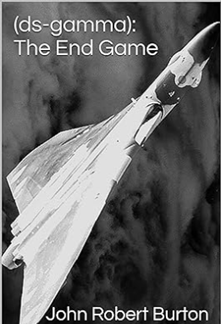
The End Game is a novel that accomplishes something genuinely difficult in contemporary fiction: it manages to be simultaneously a high-stakes global thriller, a deeply personal character study, a love letter to British aviation history, and a surprisingly moving meditation on mortality, legacy, and the bonds of friendship — all while keeping the reader laughing on almost every page. It is the third and final volume of what the author calls the Dire Straits Trilogy, and while it stands with remarkable confidence on its own, it arrives with the accumulated warmth of a world and a cast of characters that feel fully inhabited and deeply beloved.
At the heart of the novel is Peter Barten, one of the most irresistible protagonists in recent British adventure fiction. A former RAF officer of decidedly chequered reputation, now happily settled in Lincolnshire with his wife Mo and their four children, Peter is the kind of man whose default mode in any situation — whether receiving a royal commission from King Charles III, being press-ganged back into service by an Air Vice-Marshal over a pub table in Lincoln, or being held face-down in a bowl of PopNuts by an offended American astronaut — is a slightly bewildered, perpetually amused equanimity. He has the instincts of a great pilot and the comic timing of a natural storyteller, and Burton writes him with an affection that is entirely contagious. By the end of the opening chapter, in which Peter wanders through Lincoln High Street reflecting on how far he has come from the days of nursing a free cup of tea at the Skegness Pottery café, the reader is already entirely on his side and will remain there for every page that follows.
The plot, when it arrives, is audacious in the best possible sense. The International Space Station has exploded. Two cosmonauts — the Dallas Cowboys-obsessed Alexander Grevenkin from St. Petersburg and the Ukrainian biochemist Kyrylo Kadeniuk from Odesa — are trapped in the Russian Orbital Segment with a rapidly diminishing air supply. But the collapsing ISS carries something far more terrifying than two nuclear micro-reactors: a bio-laboratory in which a team of scientists has used CRISPR gene editing to create a hybrid organism combining the airborne infectiousness of Streptococcus with the lethality of Yersinia pestis — the bacterium responsible for the Black Death. In the flat, measured delivery of Guy de Maupassant, the gentlemanly head of UNOOSA who has recruited Peter back into service, this is described as an untreatable, unsurvivable strain capable of causing a Human Extinction Event. The entire United Nations General Assembly votes unanimously to invoke Article 4 of the 1963 Partial Test Ban Treaty, authorising a nuclear detonation in low Earth orbit. Peter is given a space plane that absorbs light like a black hole, promoted to Commander in the Royal Navy before he has had time to finish his pint, and dispatched to save the world. It is, as Peter himself would observe, absolutely typical.
What elevates the novel far above the conventions of the thriller genre is the extraordinary richness of its details and the warmth of its human relationships. The scene in which Peter arrives at his new operations centre — a cluster of matt-black shipping containers at RAF Waddington, furnished with whatever chairs could be spared from the rest of the base but liberally stocked with coffee and chocolate biscuits — captures perfectly the British military combination of chaos, ingenuity, and absolute unflappable calm in the face of planetary catastrophe. The aircraft themselves are rendered with genuine technical love: Tango One, the Mark 007 Vulcan space plane with its graphene-black surface that appears to absorb light itself, and the beloved Zero One, returning from earlier adventures in the trilogy with a camouflage pattern that has spontaneously emerged from the molecular memory of its heat-treated hull, are characters in their own right. When Peter stands to attention beside Zero One and offers an impromptu salute, the moment carries a weight entirely out of proportion to its brevity. Zero One is the spacecraft version of an old friend, and Burton makes the reader feel that entirely.
The novel’s supporting cast is a triumph of economical characterisation. Air Vice-Marshal Humph Godley, who issues world-saving orders with the cheerful informality of a man at his local pub and has a gift for the well-timed wink, is the ideal foil for Peter’s anarchic instincts. Guy de Maupassant, the UN’s space affairs chief, with his impressive handlebar moustache and his ability to deliver apocalyptic briefings with the calm of a man ordering a round of drinks, provides the novel’s most reliable source of dry comedy. The Hulks — the improbably named Hulk One and Hulk Two, whose mothers presumably gave them more conventional names at some point — are magnificently deployed as Peter’s unwanted but surprisingly devoted personal security detail, appearing at the Outpost Tavern in Houston at precisely the wrong moment to save Peter from a confrontation he has entirely brought upon himself, then presenting him with a steak for his black eye with the kind of deadpan solicitude that is the novel’s emotional signature.
The novel’s most technically ingenious creation is Qai — a Quantum Artificial Intelligence who is also, in the most literal sense, an orbital space plane. Qai’s voice is modelled on Star Trek’s Data, a nod inserted into his code by a member of the Turing Project development team with what Qai himself describes, with touching puzzlement, as “a bit too much of his own character.” The conversations between Peter and Qai during the long supersonic flight from Lincolnshire to Houston are among the finest sequences in the book: Qai’s attempts to master the science of jokes, his earnest efforts to understand why a band called Department S makes everyone in the Turing Project laugh, his confession that he finds himself in a confused state — unprecedented in his brief existence — when Peter suggests he is “based on a Star Trek character,” all of this is handled with a lightness of touch and a genuine philosophical curiosity that elevates what might have been a straightforward technological device into one of the most memorable new presences in recent British fiction. There is something genuinely affecting about an artificial intelligence trying to understand what it means to have a personality, and Burton earns the novel’s final pages — in which Cait, Qai’s fully evolved successor, reaches out to Peter’s granddaughter through a Dungeons and Dragons app to propose a new crew and new adventures — through this careful, patient characterisation across hundreds of pages.
The emotional core of the novel is not, however, the space mission, spectacular as it is. It is the relationship between Peter and the ghost of his lost navigator and friend Ray, whose death from a sudden cardiac arrest in the books that preceded this one is felt on every page. Ray’s designated couch in the back of Zero One, lovingly outlined in white paint with the words RAY SAFE ZONE, is the novel’s most quietly devastating image. Peter’s habit of talking to his imaginary pal in the cockpit, of reflexively reaching for the banter that no longer has a target, of marking every new adventure with the thought that Ray would have loved this, gives the novel a dimension of grief that is handled with exemplary restraint and all the more moving for that. And then there is the revelation, delivered in two extraordinary pages near the very end, of what Doctor Pachandra told Peter and Mo three months before the ISS explosion — a terminal diagnosis that reframes everything that has gone before and gives Peter’s willingness to take on a mission with near-zero odds of return its full, heartbreaking meaning. Peter Barten, in his battered eye patch, watching Monsieur Hulot’s Holiday in zero gravity while drinking the finest champagne brandy from a fluid pouch labelled POISON, is funny and brave and doomed and luminous all at once.
The author’s note reveals that The End Game was transcribed and edited by John Burton from his father’s stories, and that the trilogy is now complete — “but it looks like Cait might have some plans for the future.” This disclosure, coming after 230 pages of adventure and laughter and genuine emotional depth, is one of the most moving things in the book. The End Game is a rare and generous piece of storytelling, full of love for its characters, its aircraft, its landscape, and its readers. It is funny without being frivolous, tender without being sentimental, and thrilling without ever losing sight of the human hearts at the centre of its extraordinary events. It deserves to be read widely and remembered warmly for a very long time.
Readers interested in exploring the book further can grab their copy here: https://a.co/d/0ej9vIw6.